Hillel Yaffe Medical Center is the first and only hospital in Israel to use a sophisticated robot to dispense medications to patients. Advantages: prevention of errors when prescribing and dispensing medications, and freeing up valuable work time for staff
Last month the HMYC pharmacy was equipped with a sophisticated, robotic system that dispenses medications to the various departments, while crosschecking the patient’s medical information against the prescription given by the attending physician.
Why do we need it and how does it work?
Dr. Eyal Schwartzberg, Director of Pharmacy Services and Laboratories said, “Most hospitals in

The pharmacist enters the instructions for the robot
Schwartzberg explained, “The tremendous advantage of the robot is that it catches and prevents problems with medications before they occur. Moreover, gathering and dispensing medications becomes the responsibility of the pharmacy, and the robot enables quality control at several points in the process:
-
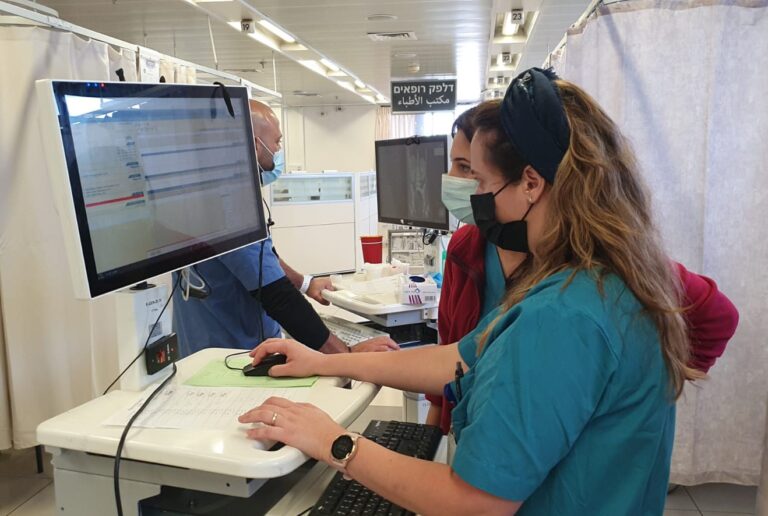
When receiving the prescription from the departments – After the nursing staff transfers the prescription to the pharmacy, the certified pharmacist enters it into the computer (a clinical prescription control system), checks dosages and other problems with the prescription and medication (if any). The software crosschecks drug information against the data on hospitalization of the patient to ensure that the best possible drug has been prescribed, without redundancies, contraindications or sensitivities between the medications the patient receives.
-
Medications gathered without human involvement – After the prescription is entered, the robot receives an instruction and gathers the medications with the exact dosage, while checking the expiration dates and ensuring that packaging is intact. It then prints the instructions for the patient, including the date and time the medications are to be taken, and puts this into a sealed bag marked with the patient’s details and identifying barcode.
-
Checking the bags and transferring them to the department – The personal bags are transferred to the department and dispensed by the nursing staff in special carts with the patient’s name. If a patient has left, the bag is returned intact to the pharmacy, returned to the robot which checks that it is intact and verifies the expiration date. It is then returned to the inventory for reuse.
This creates a situation in which there are several important controls en route – in terms of the prescription, expiration date, dosage, type of medication, and ensuring that no unused medications are disposed of or lost.
Furthermore, the nursing staff gains time (hundreds of hours each month) that was previously invested in preparing and gathering the medications so they can be dispensed to the patient. This time can now be spent providing more care for patients.
 |
 |
Left: array of medications in the cabinet, as arranged by the robot
Right: the end of the process – the personal bag with the medications
each patient receives
First when it comes to quality too
The robotic system, which as previously stated is the first of its kind in
The integration of the robot is part of the hospital administration’s strategy to promote patient safety by improving the quality of medicinal care. It is the direct continuation of the unit dose method of dispensing that has been used quite successfully for several years now in the internal medicine departments and prevents errors and problems in medicinal care. When this method is adopted, the medications are dispensed by the pharmacists in the pharmacy into the drawers of a dedicated dispensing cart, according to the dosage determined by the physicians and checked by the pharmacy staff, and are transferred directly to the department at set times. This method earned the pharmacy the Quality and Excellence Prize from the Civil Service Commission in 2009.
An item that aired on the Channel 2 news: “The robot that knows how to dispense medication,” April 9, 2012
Item broadcast on Hot 3 news in central